Flooring Services in the Inland Empire: What We Actually Do
People find us searching for a lot of different things: a flooring contractor, a hardwood company, someone to fix a squeak. This is a straightforward rundown of everything we actually do across the Inland Empire, so you can work out which one you need.
Installation
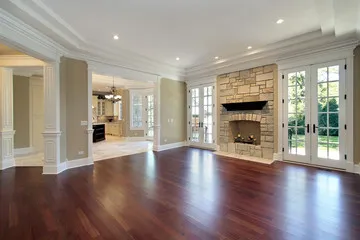
Hardwood flooring installation covers both solid and engineered. Solid hardwood can be refinished many times across its life, which makes it the long-term choice over a wood subfloor above grade. Engineered has a genuine hardwood wear layer over a cross-laminated core, which handles slab moisture and our dry-climate movement far better, and it is the practical way to get real wood in most Inland Empire homes.
Luxury vinyl plank is the waterproof workhorse. Kitchens, baths, laundry, entries, and anywhere pets and kids are hard on a floor. Unbothered by slab moisture and the most forgiving option we install.
Laminate flooring gives a hard, scratch-resistant surface at a lower cost, and works well in dry living areas and bedrooms with a proper moisture barrier over a slab.
Stair installation is its own craft rather than flooring with steps. Every tread is cut and fitted to its own opening, notched around skirt boards and balusters, and given a finished nosing. It is priced per piece rather than per square foot for exactly that reason.
Refinishing
Hardwood floor refinishing sands a floor to bare wood and rebuilds the color and finish. It brings a floor you already own back to new for a fraction of replacement cost.
Screen and recoat is the gentler version — abrading the existing finish and adding a fresh protective layer without sanding to bare wood. It costs far less, and recoating on a sensible cycle is what lets a floor go many years before it ever needs a full sanding.
Sand and stain is what you need if you are changing color, since stain only soaks into bare wood.
Dustless refinishing captures the great majority of sanding dust at the source rather than letting it settle through the house.
Repair
Not every damaged floor needs replacing, and we would rather tell you that than sell you a replacement.
Floor repair covers individual damaged boards, which can be cut out and woven back into the existing pattern so the repair disappears once the area is sanded and finished with the surrounding floor. It also covers squeaks, which are movement rather than damage and are almost always fixable once the cause is diagnosed.
Scratch and gouge repair handles localized damage without redoing a room.
Water damage repair is its own thing. The critical point is that a cupped floor must not be sanded until it has fully dried and flattened, which takes weeks. Sanding a still-swollen floor produces permanent crowning that is much harder to fix than the original cupping.
What the Inland Empire specifically demands
Two local realities shape nearly every job here.
Most homes sit on concrete slabs, which pass moisture vapor upward continuously. That is why we moisture-test the slab before installing anything, and why solid hardwood directly over concrete is generally the wrong call.
And our dry climate pulls moisture out of wood for much of the year, so boards shrink and gaps open. Acclimating flooring inside the home before installation is what keeps that within a range you never notice. It costs days nobody can see, which is exactly why rushed crews skip it.
Where we work
San Bernardino, Riverside, Highland, Redlands, Rialto, Loma Linda, Fontana, Rancho Cucamonga, Ontario and Corona. If you are not sure which service you need, that is a normal place to start — we will look at the floor and tell you honestly.
Frequently asked questions
- What flooring services do you offer?
- Hardwood installation in both solid and engineered, luxury vinyl plank, laminate, stair installation, hardwood refinishing including sand-and-stain and dustless refinishing, screen and recoat, and floor repair covering damaged boards, squeaks, scratches and water damage.
- Do I need a full refinish or just a recoat?
- Try a water test on a worn area. If water beads up, the finish is still protecting the wood and a recoat is likely enough. If it soaks in or darkens the wood, the finish has worn through and a full sand is needed. A color change always requires a full sand, since stain only soaks into bare wood.
- Why do you moisture-test the slab?
- Most Inland Empire homes sit on concrete slabs, and concrete passes moisture vapor upward continuously even when it looks dry. Installing over an untested slab is the leading cause of flooring failures a year or two later. The test is straightforward and far cheaper than redoing a floor.
- Can a damaged floor be repaired instead of replaced?
- Very often, yes. Individual damaged boards can be cut out and woven back into the existing pattern so no patch outline shows. Squeaks are movement rather than damage and are almost always fixable. Repair costs a fraction of replacement and reuses wood you already own.