Can You Put Hardwood on a Concrete Slab? (Inland Empire Homes)
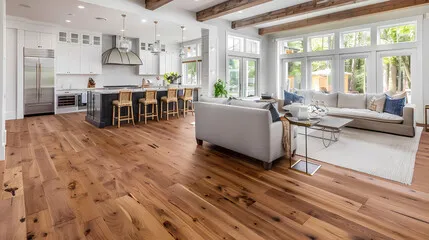
If your house was built in the Inland Empire after about 1990, it is almost certainly slab-on-grade. No crawlspace, no floor joists, just a concrete slab poured on the dirt with the house built on top of it.
That is the single most important fact about your floor, and it is the reason "can I have hardwood?" has a longer answer here than it does in older parts of the country.
The short version: yes, but it changes which hardwood and how it goes down.
Why concrete is the problem
Concrete looks inert. It is not. A slab poured on soil is in permanent contact with ground moisture, and it passes some of that moisture upward as vapor, continuously, for the life of the house.
That is fine for tile and fine for luxury vinyl plank. It is a genuine problem for wood, which absorbs moisture, expands, and then contracts when it dries. Do that under a floor that is fastened down and you get cupping, crowning, gapping, and in bad cases planks that lift off the slab entirely.
A slab also cannot be nailed into, which rules out the traditional install method on its own.
Solid hardwood on slab: technically possible, usually not the answer
Solid 3/4-inch hardwood is normally nailed to a wood subfloor. On a slab there is nothing to nail to, so the options are gluing it directly to the concrete or building a plywood subfloor over the slab first and nailing to that.
Both work. Both are done. Neither is what we usually recommend, for three reasons:
- Solid wood moves more. It is a single piece of wood, so it expands and contracts across its width with every seasonal humidity change. Directly over a moisture source, that movement is what you are trying to avoid.
- Building a plywood subfloor raises the floor by three-quarters of an inch or more, which creates problems at door thresholds, at the base of stairs, and at transitions to tile.
- It costs meaningfully more than the alternative that performs better.
If you have your heart set on solid hardwood on a slab, it can be done, and we will tell you honestly what it involves. See our solid hardwood guide.
Engineered hardwood: the right tool for a slab
Engineered hardwood is real wood, a genuine hardwood wear layer, bonded to a multi-ply plywood core. The plies are cross-laminated, each layer running perpendicular to the one below it, which is what makes the plank dimensionally stable. Cross-grain construction fights the movement that plain-sawn solid wood cannot resist.
Practically, on a slab, that means:
- It handles the moisture vapor a slab gives off without cupping
- It can be glued directly to concrete or floated over it, no plywood buildup, no height problem
- It comes in wider planks than solid wood can manage here, 5 inches and up, which is what most people want and what solid wood struggles to deliver stably in this climate
- With a 3mm or thicker wear layer it can still be refinished once or twice
The honest limitation is refinishing. Solid wood gives you four to seven refinishes. Engineered gives you one or two, and a thin 1mm wear layer gives you none. If you are buying engineered, the wear layer thickness is the number that matters most, ask for it and get it in writing.
The step nobody should skip: moisture testing
Before any wood goes over any slab, the slab gets tested. Not looked at. Tested.
Two standard methods: a calcium chloride test that measures how much vapor comes through in 24 hours, and relative humidity probes set into holes drilled in the slab. Either gives you a number.
That number drives everything downstream, whether a moisture barrier or a vapor-retarding adhesive is needed, whether a floating install is safer than a glue-down, and occasionally whether wood is the right material at all.
This is where slab jobs go wrong. A crew that skips the test, glues wood to a slab that is passing more moisture than the adhesive can tolerate, and leaves, has installed a floor that will fail in year two. The homeowner blames the wood. It was never the wood.
Ask any contractor how they will test slab moisture and what number they need to see. If the answer is vague, keep looking. Our guide on choosing a flooring contractor in the Inland Empire covers the rest of the questions worth asking.
The three install methods on slab
Glue-down. Engineered planks adhered directly to the slab with a moisture-control adhesive. Feels the most solid underfoot, closest to nailed hardwood, quiet, no hollow sound. Requires a genuinely flat, clean slab. This is what we recommend most often.
Floating. Planks joined to each other over an underlayment, not attached to the slab. Faster, less expensive, and tolerant of a slab that is not perfectly flat. Slightly more sound underfoot. Good choice when slab moisture readings are high, because the underlayment can include a vapor barrier.
Plywood subfloor over slab. Plywood fastened down first, then nail-down hardwood over it. The only route to genuine solid hardwood, and the one that raises the floor height.
Flatness matters as much as moisture
One more thing specific to slabs: they are rarely flat. Poured concrete has high spots and low spots, and tolerances that were fine for carpet are not fine for a rigid plank floor.
High spots get ground down. Low spots get filled with self-leveling compound. This happens before installation, and on an older slab it can be a meaningful line item. It is not an upsell, a plank floor over an uneven slab flexes at every step, and flexing is what breaks locking edges and pops glue bonds.
What we would tell a neighbor
For a slab home in San Bernardino, Fontana, Rancho Cucamonga, or anywhere else across the valley: engineered hardwood with a 3mm or thicker wear layer, glued down, after a moisture test and whatever flatness prep the slab needs.
That floor looks identical to solid hardwood, behaves better on concrete, keeps your door heights, and can still be refinished when the time comes.
Want to know what your slab is actually doing? Book a free in-home estimate and we will take a look before recommending anything.
Frequently asked questions
- Can you install hardwood floors on a concrete slab?
- Yes. Engineered hardwood is the right choice for slab-on-grade homes because its cross-laminated plywood core resists the movement caused by moisture vapor coming up through concrete. It can be glued directly to the slab or floated over it. Solid hardwood on slab requires either direct glue-down or building a plywood subfloor first.
- Why can’t you nail hardwood to a concrete slab?
- There is nothing to nail into. Traditional nail-down installation fastens planks to a wood subfloor over joists. On slab-on-grade construction the options are gluing the flooring to the concrete, floating it, or first building a plywood subfloor over the slab and nailing to that.
- Does a concrete slab need to be moisture tested before hardwood?
- Always. Concrete poured on soil passes moisture vapor upward continuously. A calcium chloride test or in-slab relative humidity probes give a number that determines whether a moisture barrier or vapor-retarding adhesive is needed and whether glue-down or floating is safer. Skipping this test is the most common cause of slab flooring failures.
- How thick should the wear layer be on engineered hardwood?
- Look for 3mm or thicker if you want the option to refinish once or twice over the floor’s life. Budget engineered products with a 1mm wear layer cannot be sanded at all, which means damage and wear can only be addressed by replacing planks.