Restoring Historic Hardwood Floors in Redlands and Riverside
If you bought a pre-1950 home in Redlands, Riverside's Wood Streets, or the older neighborhoods of San Bernardino - you probably have hardwood under your carpet. Restoring it is some of the most rewarding work we do.
What's likely under your carpet
1900s - 1920s craftsman bungalows: Douglas fir or old-growth pine, usually 3" - 4" wide tongue-and-groove, sometimes with mahogany or oak feature borders in the formal rooms.
1920s - 1940s Spanish revival and craftsman: Quartersawn white oak strip, 2-1/4" or 3-1/4". Tighter grain than modern oak - exceptional wood that doesn't exist in commercial supply anymore.
1940s - 1960s ranch: Red oak strip, 2-1/4". Solid 3/4" thick. Almost always refinishable.
1960s - 1970s ranch: Mix of oak strip and parquet. Parquet is harder to refinish well but possible.
Assessing what you have
- Pull a vent register and look at the cross-section. You'll see the wood thickness, type, and what's underneath.
- Check a closet corner. Closets often skip carpet, leaving original wood exposed.
- Lift carpet at a corner. A few staples and you can see what's under without committing.
What you're looking for:
- Wood thickness above the tongue and groove. 1/8 inch minimum to refinish. More is better.
- Major water damage or staining. Some fades with refinishing; some doesn't.
- Patches or repairs. Previous owners may have replaced sections - needs assessment for whether the patch can be matched.
- Layout direction and pattern. Original layouts are usually beautifully thoughtful - running parallel to the longest wall, with feature borders.
What restoration involves
- Carpet, pad, and tack strip removal. Tack strip nails leave a visible perimeter that needs filling or replacement.
- Staple and tack removal. Done by hand. Time-consuming on full houses.
- Sub-board repair. Cracked or split boards get woven in with matching salvaged stock when possible.
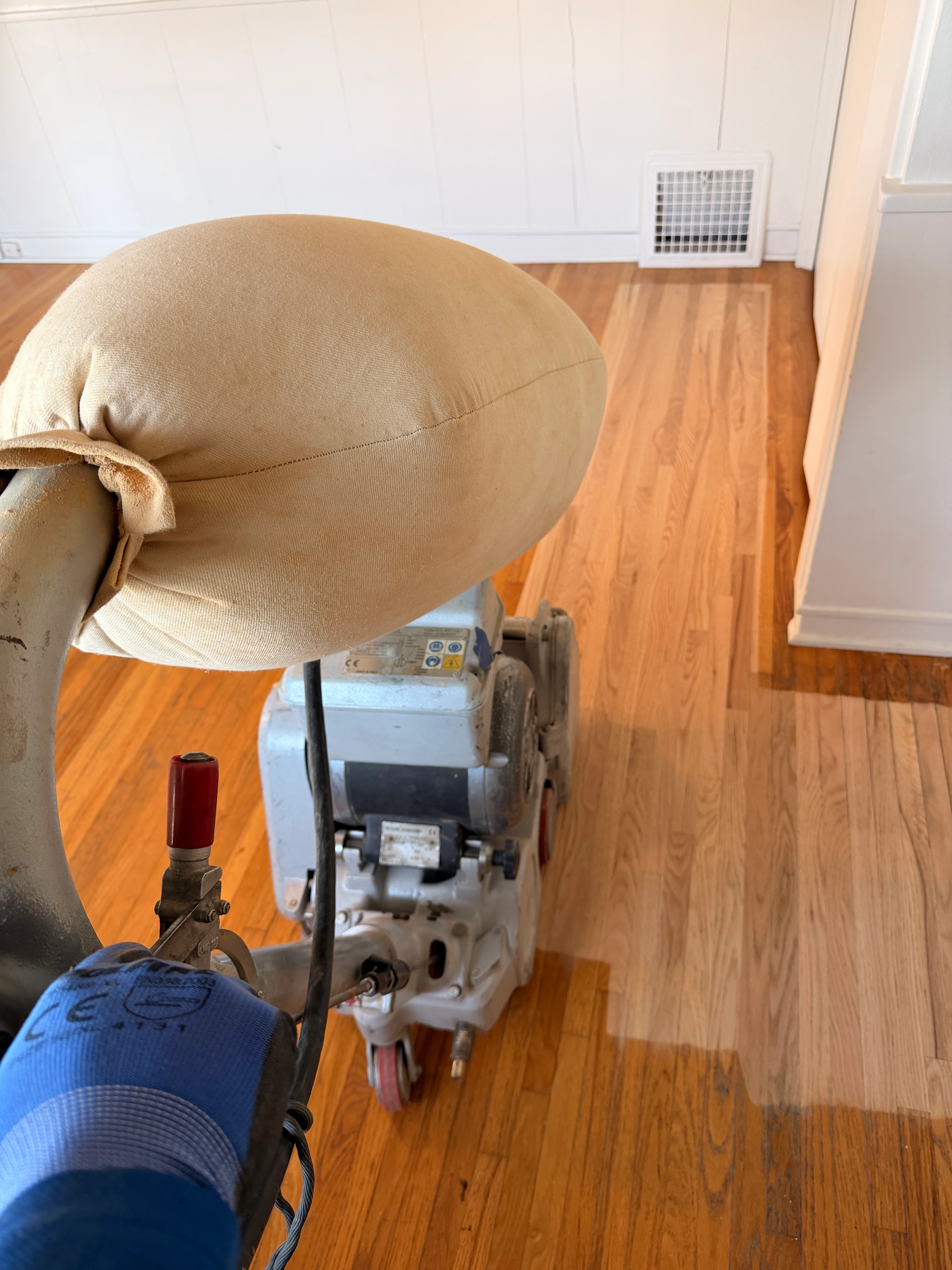
- Coarse, medium, fine sanding. Heavy-grit through fine to bring up the original grain. Hand-edged where the drum sander can't reach.
- Stain (or natural). Most historic restorations look incredible with no stain - the patina of old-growth wood is part of the appeal. Some homes get a light tone applied.
- 3 coats finish. Water-based or oil-based polyurethane. Oil-based ambers nicely on old fir; water-based stays clear on white oak.
Cost reality
Historic restoration runs $4 - $8 per sq ft for the floor work itself. Compared to $10 - $14 per sq ft for new wood install (and you'd be replacing irreplaceable wood). Restoration is almost always the right call.
A note on wood you can't buy anymore
The Douglas fir and old-growth oak in pre-1950 Redlands and Riverside homes is often denser, tighter-grained wood than anything available commercially today. The trees those boards came from don't exist anymore. Don't replace them lightly.
If you're thinking about restoring historic floors, we'd be honored to take a look. It's some of our favorite work.