Can One Damaged Vinyl Plank Be Replaced Without Redoing the Floor?
A refrigerator gets dragged. A dropped knife lands point-down. A plank near the slider lifts at one corner. Now there is one obviously damaged board in the middle of an otherwise perfect floor, and the question is whether that means a new floor.
Usually it does not. Here is how single-plank replacement actually works.
First: which kind of vinyl do you have?
Everything depends on this, and you can figure it out without any tools.
Click-lock (floating). The planks lock into each other and float over the subfloor without adhesive. Press firmly near a wall or in a doorway, a floating floor has a small amount of give and may make a faint sound. There is a gap hidden under the baseboard or shoe molding around the perimeter.
Glue-down. The planks are adhered directly to the slab. There is no give at all, no perimeter gap, and the floor feels like part of the concrete.
Both are repairable. The methods are completely different.
Replacing a click-lock plank
There are two routes.
Unlock back to the plank. Pull the shoe molding on the nearest wall, then unclick rows back to the damaged board, swap it, and click everything back. This is the clean method and it leaves no evidence at all. It is practical when the damaged plank is within a few rows of a wall and the room is not full of heavy furniture.
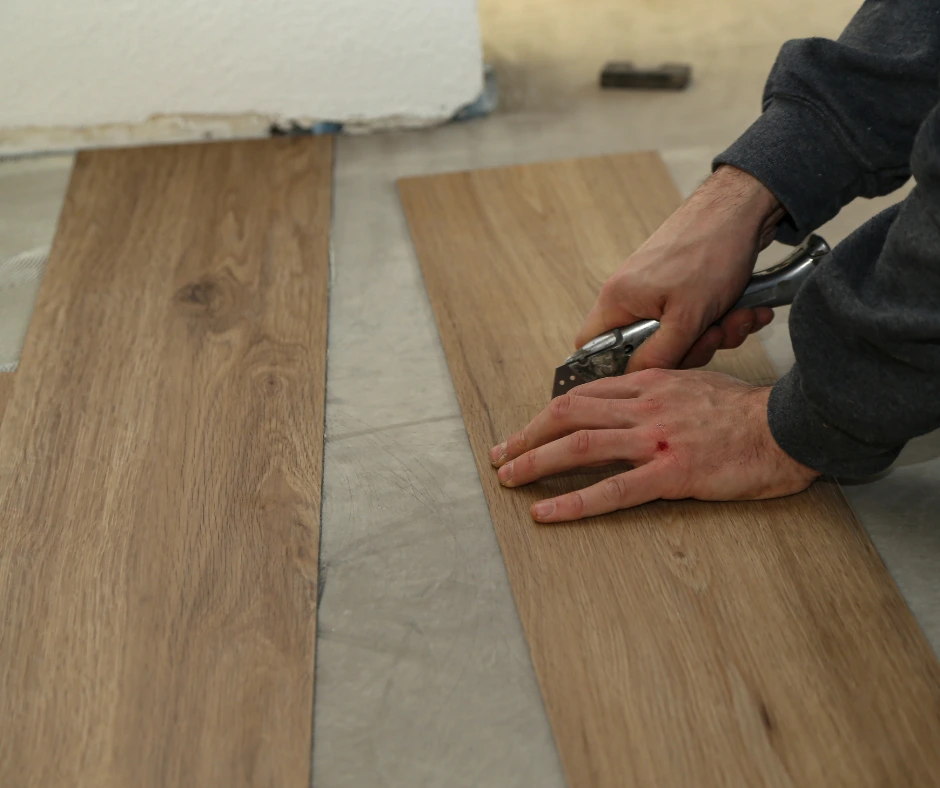
Cut it out in place. When the plank is in the middle of a large room, unlocking half the floor is not sensible. Instead the damaged plank gets scored and cut out, the locking edges are trimmed off the replacement, and it is glued into the opening. Done by someone who has done it before, this is invisible. Done casually, the repair sits slightly proud of the floor and catches light.
Our floor repair service covers both.
Replacing a glue-down plank
Heat and patience. The damaged plank is warmed to soften the adhesive underneath, then lifted out. The old adhesive is scraped off the slab, fresh adhesive goes down, and the new plank is set and weighted while it cures.
It is more work than a click-lock swap but it is very reliable, because there are no locking edges to reconcile. The slab has to be genuinely clean before the new plank goes down, adhesive over old adhesive is how you get a plank that lifts again in a year.
The real obstacle: do you have a matching plank?
This is what determines the outcome far more than the method, and it is worth saying plainly.
If you kept leftover material, you are in good shape. This is the single best argument for keeping a box of spare planks in the garage after any LVP installation. If you have leftovers, a repair is straightforward.
If you did not, it depends on the age of the floor. Manufacturers discontinue and revise products constantly. On a floor under about three years old, we can often source a match. Past five years it gets difficult, and past eight it is unlikely.
There is also dye lot. Even the same product from a different production run can differ slightly in color. And an installed floor has been living under Southern California sun, which fades vinyl over time, so a brand-new plank of the identical product can read lighter than its neighbors.
The trick when you cannot find a match
Take the replacement from a closet.
Pull a plank from inside a bedroom closet, under the refrigerator, or behind a door, somewhere nobody looks, and use it for the visible repair. Then put the imperfectly matched new plank in the hidden spot.
The eye is very good at spotting a mismatch in the middle of a living room and completely blind to one inside a pantry. This costs nothing and it is the difference between a repair you notice and one you do not.
When replacing a plank is the wrong answer
Three situations where a spot repair is treating a symptom:
Water underneath. If a plank lifted, cupped at the edges, or the floor feels soft nearby, the problem is moisture under the floor rather than the plank on top. A slab passing moisture, a failed slider seal, or a slow plumbing leak will ruin the replacement too. Find the water first. Our water damage floor repair guide covers what to look for.
Multiple planks failing along seams. Widespread edge damage usually points at an installation problem, an uneven slab, a missing expansion gap, or the wrong underlayment, not at individual bad planks.
The plank is peaking or the floor is buckling. A floating floor that has nowhere to expand pushes up. The fix is restoring the expansion gap at the perimeter, not swapping planks.
Preventing the next one
- Keep a box of leftover planks. Free insurance, and the single most useful thing you can do.
- Felt pads under every furniture leg, and replace them when they compress.
- Never drag appliances. Lift them or put them on a sheet of hardboard.
- A real mat at every exterior door. Grit is what dulls a vinyl wear layer, and in the Inland Empire there is plenty of it.
Not sure what you are dealing with, or whether it is one plank or a floor-wide problem? Book a free in-home look and we will tell you straight, including when the answer is that it is fine and you should leave it alone.
Frequently asked questions
- Can a single vinyl plank be replaced without redoing the floor?
- Usually yes. On click-lock floating floors the plank can either be reached by unlocking rows from the nearest wall, or cut out in place and glued in. On glue-down vinyl the plank is warmed to soften the adhesive, lifted, and a new one is set into fresh adhesive.
- What if my vinyl plank product has been discontinued?
- Take the replacement plank from a hidden area such as inside a closet or under the refrigerator, use it for the visible repair, and put the imperfectly matched new plank in the hidden spot. This is why keeping a box of leftover planks after installation is worth doing.
- Why did my vinyl plank lift at the edge?
- Most often moisture underneath, from a slab passing moisture, a failed door seal, or a slow leak, or a missing expansion gap at the perimeter of a floating floor. Both are floor-level problems, so replacing the plank without fixing the cause means the replacement fails too.
- Is luxury vinyl plank repairable at all, or does it have to be replaced?
- Individual planks are replaceable, which is one of LVP’s practical advantages. What cannot be repaired is the plank itself, unlike hardwood there is no sanding or refinishing, so damage is addressed by swapping the board rather than resurfacing it.