Hardwood Stairs: What the Job Actually Involves
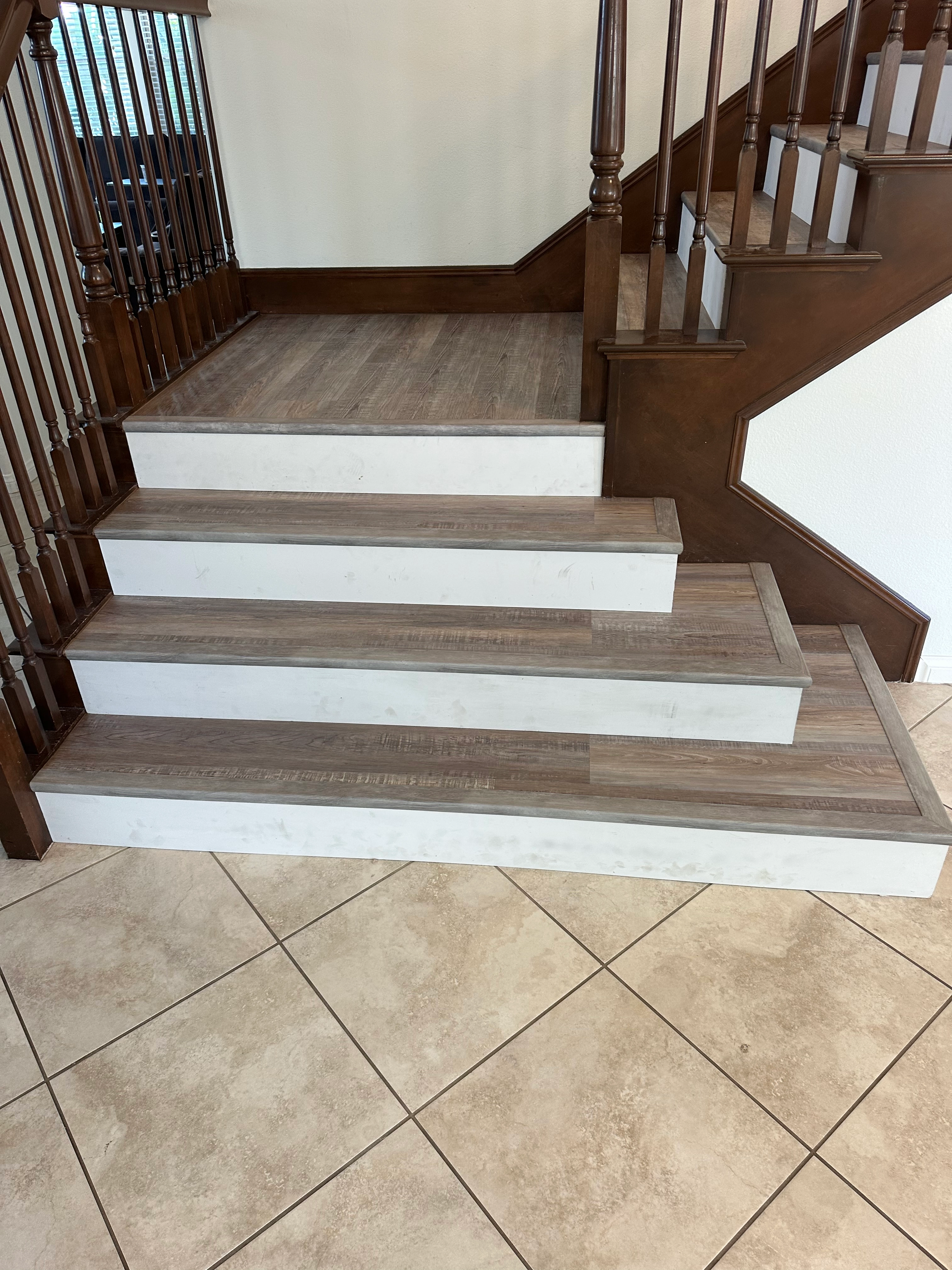
A staircase is the most demanding part of any flooring project. Every tread is cut individually, nothing in a house is quite square, and the result sits at eye level in the middle of the home where every join is visible.
It is also one of the biggest visual changes you can make. Here is what is actually involved.
The parts
Treads are the horizontal surfaces you step on. Risers are the vertical faces between them. Nosing is the rounded front edge of the tread that overhangs the riser below.
Nosing does more work than it looks like. It gives the step a finished edge, it takes most of the wear, and its profile has to match the flooring it meets at the top and bottom. Getting that transition right is what makes a staircase look like part of the house rather than an addition.
Opening up carpeted stairs
A lot of Inland Empire homes have carpeted stairs, and homeowners often assume there is nothing underneath worth having.
Sometimes there is. On older properties the stairs may be solid stock that was carpeted at some point, and refinishing what is already there costs considerably less than building new treads.
More often, particularly in newer construction, the stairs underneath are rough construction-grade material never intended to be seen. That is not a problem — it just means new treads and risers rather than refinishing.
Either way, it is worth pulling back a corner of carpet before you plan the budget. It is a five-minute check that changes the number significantly.
Why it takes longer than you expect
Stairs are not a repeatable operation. Each tread is measured and cut to its own opening, because the stringers are rarely perfectly parallel and the width often varies slightly from top to bottom.
Add a landing, a turn, or winder treads on a curved section and the complexity increases sharply — winders are wedge-shaped and each one is a bespoke cut.
That is why stairs are priced per tread rather than by area, and why a staircase can cost as much as a good-sized room.
Living with it during the work
The practical constraint people forget: it is the only route to the upstairs of the house.
We work in a way that keeps stairs usable overnight wherever possible, but there will be periods during the day when they are not, and finish curing needs to be planned around. If there is only one staircase and someone in the house has mobility limitations, tell us at the estimate and we will sequence around it.
Matching to your floors
If the stairs are being done alongside new flooring, matching is straightforward because the material comes from the same batch.
If the floors already exist and you are only doing the stairs, matching is harder. Your existing floor has aged and changed colour under Inland Empire sun, so brand-new material in the same species will not match on day one. We do sample stains against the actual floor rather than working from a colour name, and sometimes the honest answer is a deliberate contrast rather than a near-miss.
Grip, which nobody asks about until later
Hardwood stairs are more slippery than carpeted ones. It is worth deciding early whether you want a runner, because a runner changes the tread finish decision — there is no point paying for a premium finish on the middle of a tread that will be covered.
Our stair installation service covers the full scope, and if the stairs are part of a larger project our hardwood installation page covers the rest. Book a free estimate and we will look at what is under the carpet before pricing anything.
Frequently asked questions
- Can you put hardwood on existing carpeted stairs?
- Usually yes. What is underneath decides the method: solid stock that was carpeted over can sometimes be refinished, while rough construction-grade stringers need new treads and risers fitted over them. Pull back a corner of carpet before budgeting.
- Why do stairs cost so much compared to a room?
- Because nothing repeats. Every tread is measured and cut individually to its own opening, the risers and nosing are separate pieces, and all of it is finished to a standard that holds up at eye level. Stairs are priced per tread for that reason.
- Can we still use the stairs during the work?
- For most of the time, yes, though there will be periods during the day when a section is unusable and finish needs time to cure. If it is the only staircase, tell us at the estimate and we will plan the sequence around the household.
- Will new stairs match my existing floors?
- Not automatically, because your existing floor has aged and changed colour under sun exposure. We stain samples against the actual floor rather than matching to a product name, and sometimes a deliberate contrast reads better than an almost-match.